New for technology leaders
AI is the easy part.
Why AI Creates Capability, but Organisations Create Value
Your engineers are faster than ever. Your business isn't. Adoption is high, satisfaction is up, the dashboards are green, and the P&L is flat. This book shows you exactly where that gap opens in your organisation, and gives you a ninety-day plan to close it.
Available now in ebook, paperback, and hardcover.
 By Bharat Sharma16+ years leading platform & data engineering at large product companies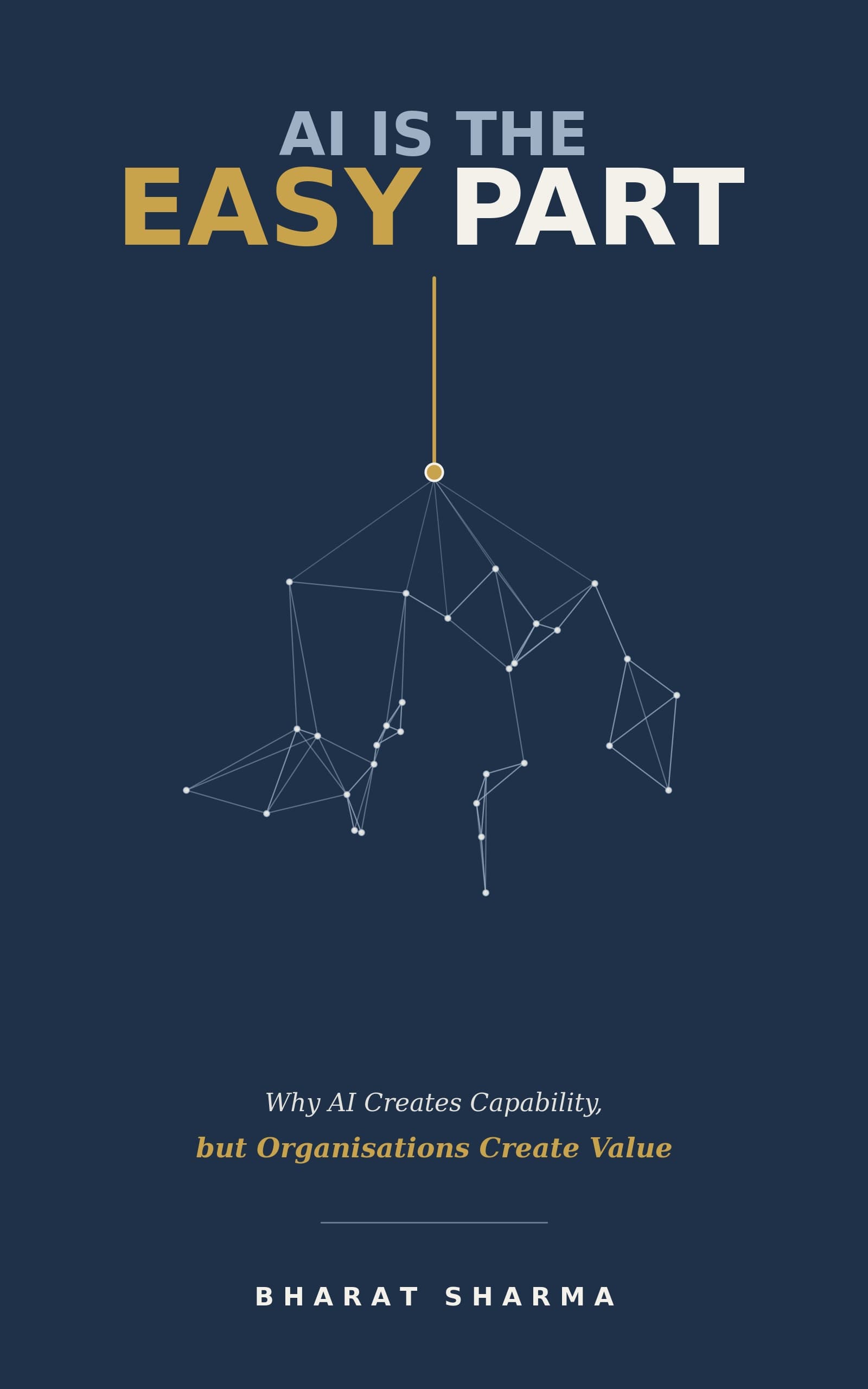
The missing explanation
The constraint didn't disappear. It moved.
AI Is the Easy Part shows that AI lifts the capability of individuals far faster than it lifts the capability of organisations. The binding constraint on value has moved: from writing code to deciding what to build, coordinating across teams, governing risk, and learning from what ships.
Grounded in evidence, not vibes: Goldratt's Theory of Constraints, the DORA research on software delivery performance, and patterns observed across real engineering organisations.
Not another AI tools roundup. Not a call to adopt harder. AI Is the Easy Part is a field guide for leaders who already know the tools work, and need to redesign the organisation around them.
First
Find where value stops
Diagnostics to locate, in your own organisation, exactly where the gains from AI quietly leak away before they reach a customer.
Second
Redesign the operating model
The platform, data, decision, governance, and agent changes that turn individual AI capability into business value.
Third
Begin on Monday
A maturity model to see where you really stand, and a ninety-day plan to start relocating the constraint on purpose.
The constraint has migrated from the keyboard to the organisation. Most leaders are still optimising the keyboard.
from AI Is the Easy Part
What you'll learn
From diagnosis to redesign
Make sharper calls on where to invest in AI, backed by a diagnostic instead of a hunch.
Stop losing AI's gains between the IDE and the P&L, by finding exactly where your organisation's value stops flowing.
Redesign the platform, data, decision, and governance layers that turn individual AI capability into business value.
Govern AI for safe speed: know when to let agents act, and lead the human side of the change without losing your best people.
For CTOs, VPs of Engineering and Product, and the transformation, platform, and data leaders building the enterprises of the AI era.
Free diagnostic
Has AI Actually Made Your Organisation Faster?
Answer fifteen questions about how work actually moves through your organisation, and see where your AI productivity is most likely getting stuck — your AI Value Conversion Score, your likely bottleneck, and three practical actions.
From the opening pages
Every individual piece had succeeded, and the whole had still produced nothing the business could feel.
The engineers weren't the problem. The tools weren't the problem. The data wasn't wrong.
The question was wrong.
Early readers
What they're saying
Every organisation I work with is producing better output with AI. Very few are producing better business outcomes. This book is the clearest explanation I've read of the gap between the two and, as the title promises, the hard part turns out to be organisational, not technical. I'd strongly recommend it to any mid-to-senior leader who has the mandate to make a step change with AI but keeps running into forces inside the organisation that no one has named yet.
Bharat approaches the topic of AI business value from a real technology practitioner's standpoint. This is not theory. This is reality. He provides excellent framing for understanding why the business value translation challenge is not a trivial one, and a very practical framework for how to unlock it.
Get the book
Get it in your country
The ebook is on Kindle stores in thirteen countries, with paperback and hardcover editions in fifteen.
Get the first chapter free.
We'll use your email address to send the sample chapter. See our Privacy Policy
For teams
Reading this with your leadership team?
The diagnostic, the maturity model, and the ninety-day plan are built to be worked through together. Almost everything they ask for — moving decision rights, changing how teams are funded, rewiring governance — is not something one reader can go and do alone.

About the author
Bharat Sharma
Bharat Sharma is an engineering leader with more than sixteen years in platform and data engineering at large global product companies. He has led sizeable engineering organisations through the gap between faster engineers and faster businesses. He writes on why AI transforms organisations, not just engineers, and lives in Bengaluru, India.