Inside the book
Not a book about AI tools. A field guide for redesigning the organisation around them.
Prologue
The Boardroom Silence
The agenda item was titled “AI-Assisted Engineering: Q3 Update,” and the Chief Technology Officer had prepared for it the way she prepared for everything, thoroughly. The numbers were genuine. She had checked them twice.
Eighty-seven percent of the company's software engineers used AI-assisted development tools every day. Not as an experiment, not as an option, but as a part of daily work as ordinary as a text editor. Developer satisfaction scores (tracked quarterly, taken seriously) were the highest they had been in five years. Pull requests merged noticeably faster. New hires who once spent three months finding their footing now shipped meaningful code within weeks. Even technical debt, the chronic complaint of every performance review, seemed to be shrinking, as teams refactored with a confidence they had never quite managed before.
She had seen a lot of technology adoptions. This one was different. “We have never seen a developer technology adopted this fast,” she told the board. She meant it.
Several members nodded. Then one of them, a former operating executive who had run three industrial businesses before joining the board, asked the question the meeting had been building towards. He asked it with the easy smile of someone who already suspects the answer.
“So what has this meant for the business?”
The room shifted. Not dramatically. No one pushed back from the table. But the quality of the air changed, the way it does when everyone arrives at the same realisation a moment before anyone says it.
“Engineers are definitely more productive—” the CTO began.
“I heard that part,” the board member said, still smiling. “I mean — are we shipping faster? Have customer outcomes changed? Has revenue moved? Are we spending less? What has actually changed for the business?”
The answers came from around the table, assembled piece by piece. Are we shipping faster? A little. How much? Hard to say exactly. Have customer outcomes improved? Not measurably. Not yet. Revenue? The pipeline hasn't moved. Cost? Too early to tell.
By the time the meeting ended, the room agreed on two things. The engineers were genuinely, measurably more productive. And the business had experienced nothing that felt like transformation.
It would be easy to read the meeting as a failure of execution, and to respond the way organisations usually respond to a disappointing quarter, with more pressure, a tighter plan, a renewed push. But nothing in the room had been executed badly. The tools worked. The engineers were skilled and willing. The rollout had been competent. That was the unsettling part: every individual piece had succeeded, and the whole had still produced nothing the business could feel. A failure of execution has a satisfying remedy: try harder, do better. This was something stranger and more important: a failure that survived everyone doing their job well, and that would not yield to effort, because effort was never what it lacked.
Walking to her next meeting, the CTO turned the conversation over in her mind. The engineers weren't the problem. The tools weren't the problem. The data wasn't wrong.
The question was wrong.
For eighteen months, the organisation had asked: How do we make engineers faster? It had answered that question well. The proof was on every slide. But it had treated engineering speed as the destination, when it was only the start of the journey. The real question, the one that connects investment to outcome, was different.
What stops faster engineering from becoming faster value for customers?
That question has a long answer. This book is that answer.
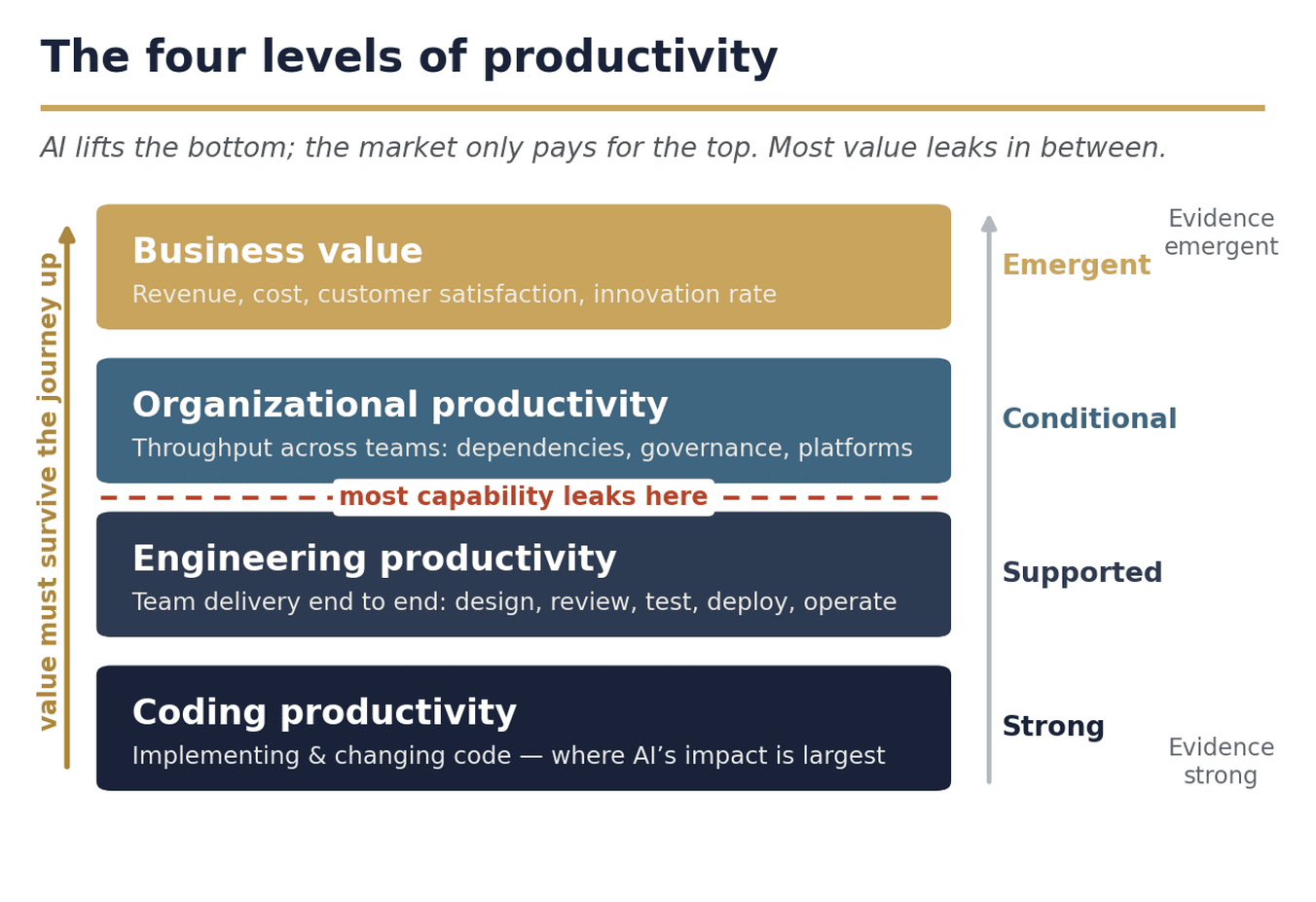
The argument in one picture
Where the gains leak away
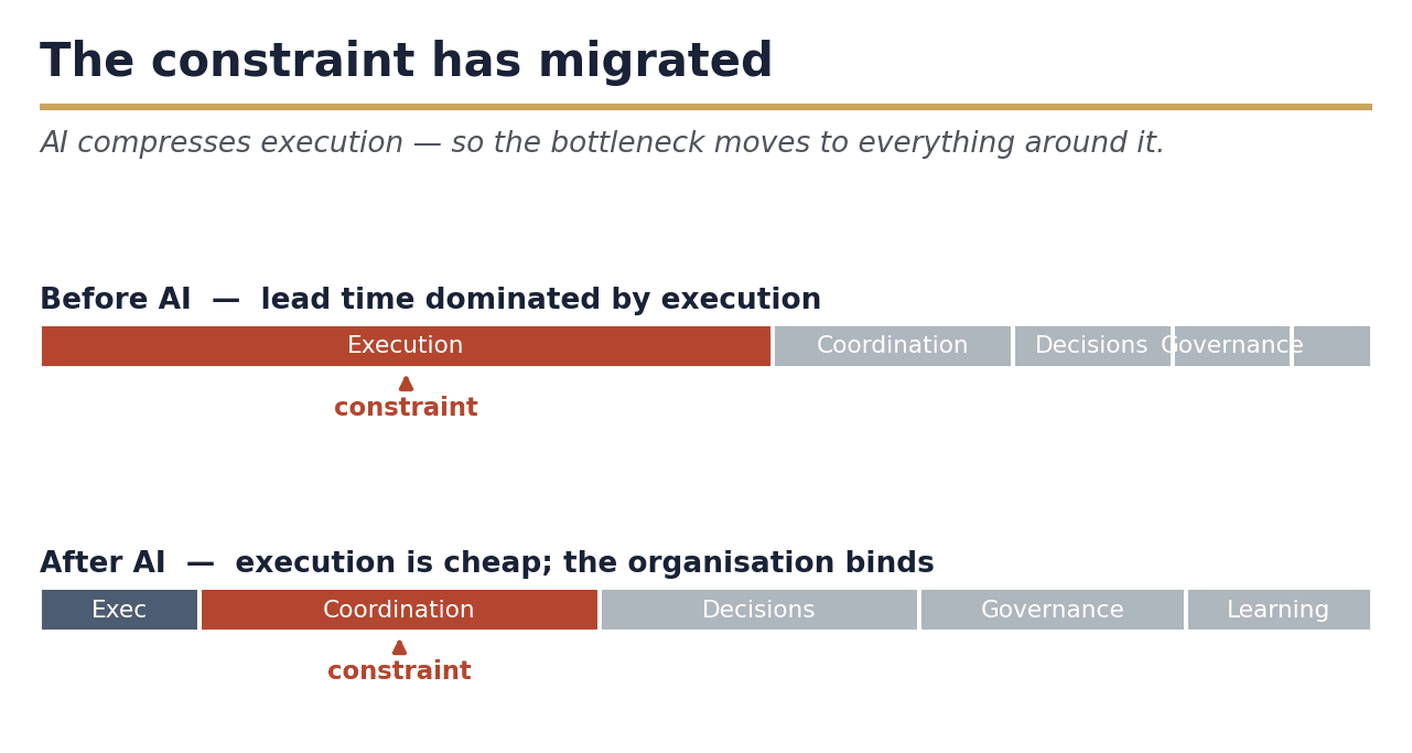
Value climbs four levels: coding productivity, engineering productivity, organisational productivity, business value. Almost all AI investment sits at the bottom level; almost all the value the board cares about lives at the top. The distance between them is where the gains leak away.
Contents
Six parts, sixteen chapters
Prologue
- ·The Boardroom Silence
Part I · The Paradox
- 1The Wrong Question
- 2Where the Time Actually Goes
- 3The Migrating Constraint
Part II · The Diagnosis
- 4Seeing Value Flow
- 5Metrics That Matter
Part III · The Substrate
- 6The Economics of AI Value
- 7Platforms and Team Topologies
- 8Knowledge and Data as Infrastructure
Part IV · The Operating Model
- 9The AI-Native Product Organisation
- 10Decisions and Governance
- 11Risk, Security, and Responsible AI
- 12From Assistants to Agents
Part V · Leadership and Change
- 13Talent and the Human Premium
- 14Leading the Change
Part VI · Becoming AI-Native
- 15Building the AI-Native Enterprise
- 16A Maturity Model and a 90-Day Start
Closing
- ·The Organisation Is the Product
Good governance is not what slows you down; it is what lets you go fast safely.
from Chapter 10
From the pages
In the book's words
What presents as an AI-adoption challenge is almost always an organisational-design challenge wearing engineering clothes.
An assistant makes a human faster. An agent changes what the human's job is.
AI does not create organisational memory; it amplifies whatever memory already exists.
Cheap execution makes a feature factory worse, not better.